Blog
Securing Amazon Bedrock Agents with CloudAgent: From Risk Discovery to Hardened Deployment
If you are building on Amazon Bedrock, the question comes up fast: how do you secure Bedrock agents without turning it into a long manual audit?
This walkthrough shows how CloudAgent helps you:
- discover which Bedrock agents are actually in scope
- surface the most important security gaps first
- tell whether a resource is managed through IaC or was created manually
- generate a remediation plan before anything changes
- deploy a hardened agent stack only after approval
For most teams, that is the hard part.
The challenge is not caring about security. It is turning concern into a clear remediation plan without a lot of manual work.
Why Bedrock agent security is hard
Bedrock agent security touches more systems than most people expect.
You are reviewing IAM policies, trust relationships, guardrails, data access, and how the resource was deployed.
That means a quick check is rarely enough. One weak trust policy or one broad permission can create unnecessary exposure.
CloudAgent helps by turning that sprawl into a simple workflow: discover, assess, verify ownership, plan remediation, and execute with approval.
Step 1: Discover agents and establish security context
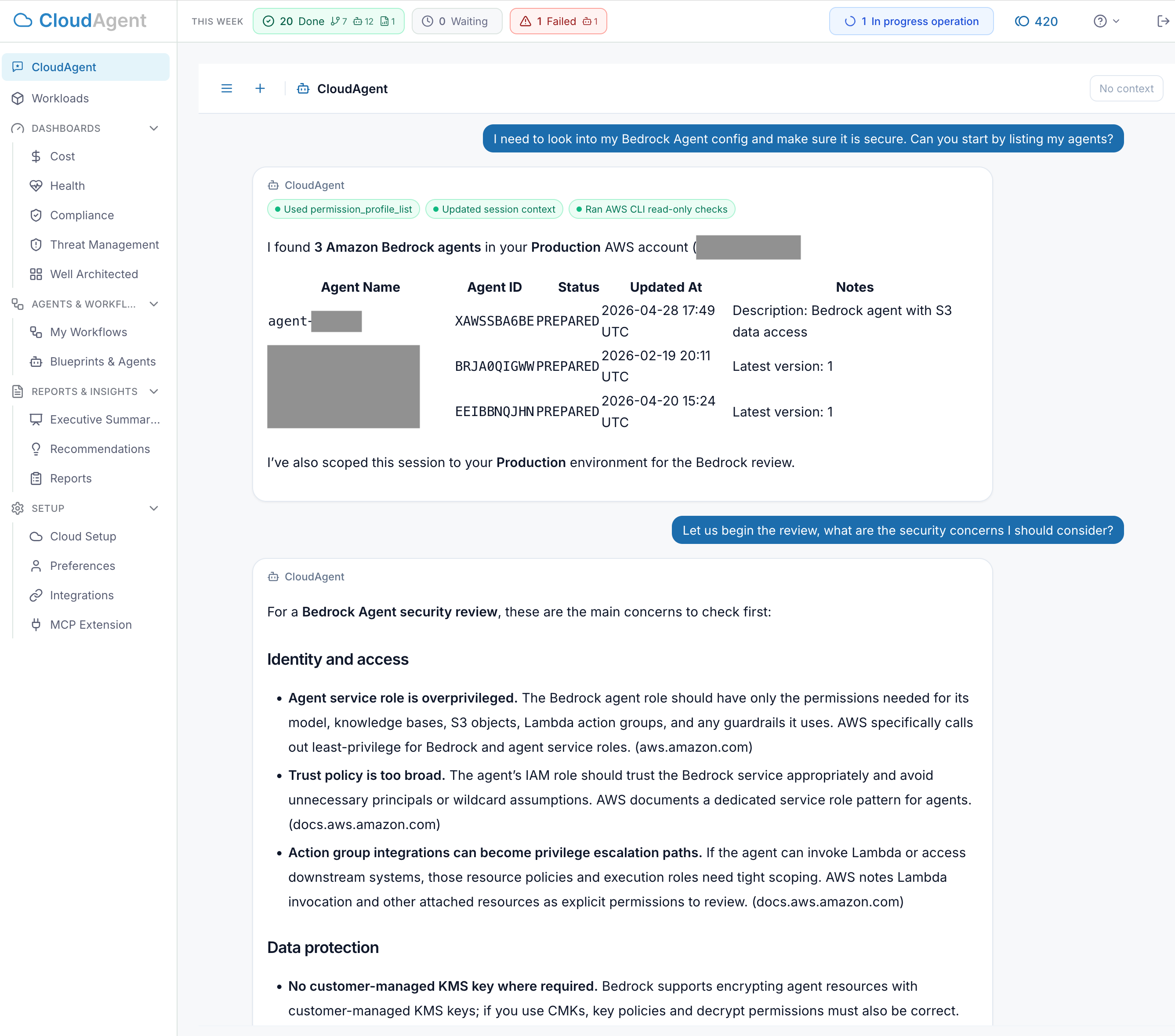
CloudAgent starts by listing the Bedrock agents in the target production account.
It frames the review around identity, access, and data protection.
It uses read-only checks first, which is what you want in production.
You get a clean inventory for the environment you care about and a clearer starting point for remediation.
Step 2: Prioritize the highest-risk findings first
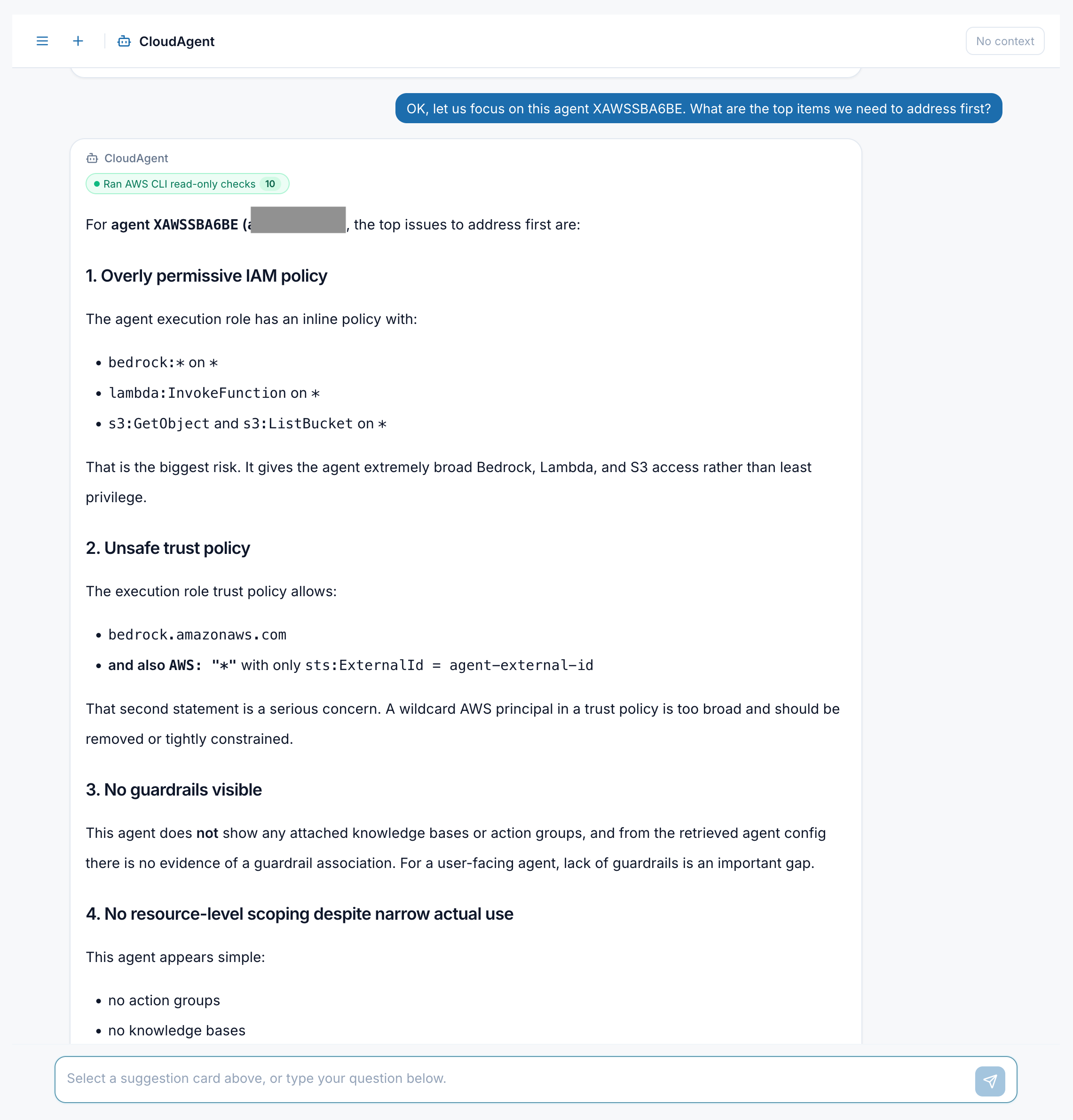
Once the agent is identified, CloudAgent highlights the issues that matter first.
In the example shown here, those include:
- overly permissive IAM access, including wildcard actions and resources
- unsafe trust policy design
- missing or unverified guardrails
- weak resource-level scoping
The output is specific.
Instead of a generic checklist, you get concrete problems and a faster path to triage.
Step 3: Check if the agent is managed by IaC or created manually
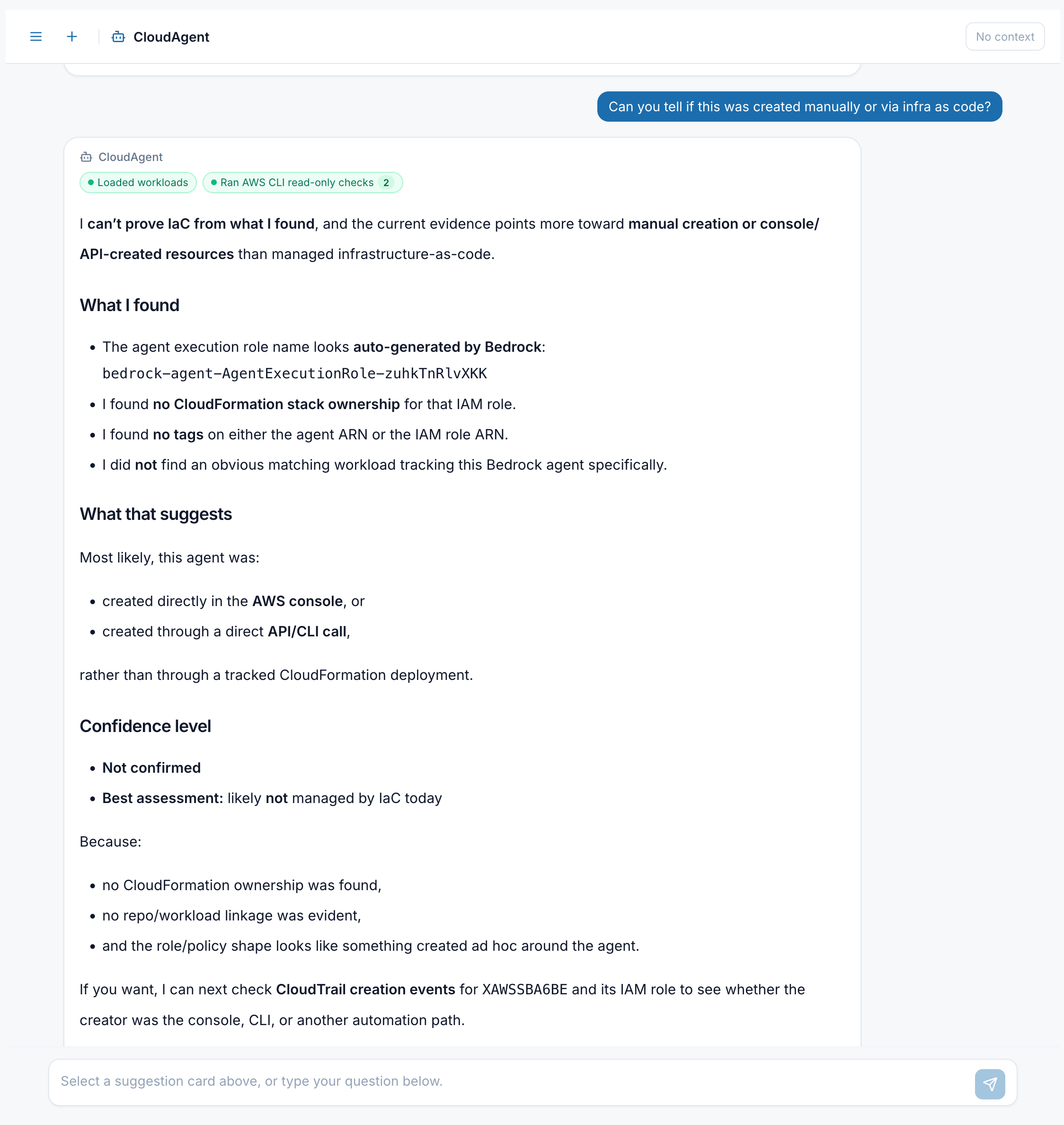
Security is only part of the story.
You also need to know whether the agent is managed through IaC or was created manually.
CloudAgent checks for signals like CloudFormation ownership and expected tags, then explains the result.
In this example, the signs point to likely manual creation through the console or API.
That matters because the fix may require both remediation and a process change.
Step 4: Generate a review-first remediation plan
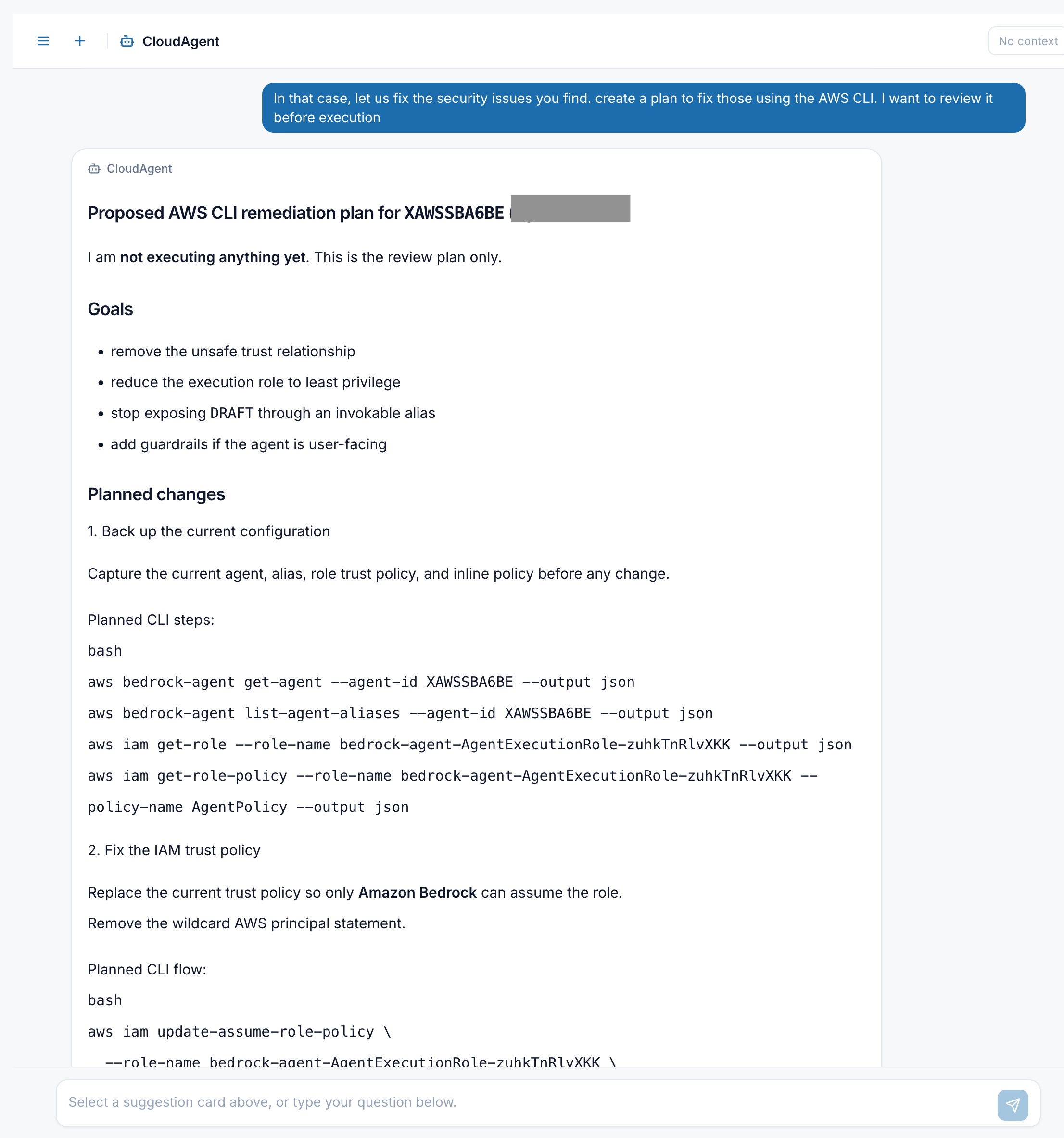
Before anything is modified, CloudAgent lays out a step-by-step remediation plan using AWS CLI actions.
It starts with backup and state capture, then moves into tightening trust policies and reducing permissions.
The workflow stays review-first.
There are no surprise write actions, and the commands map directly to the risks found earlier.
Step 5: Approve and deploy a hardened Bedrock agent stack
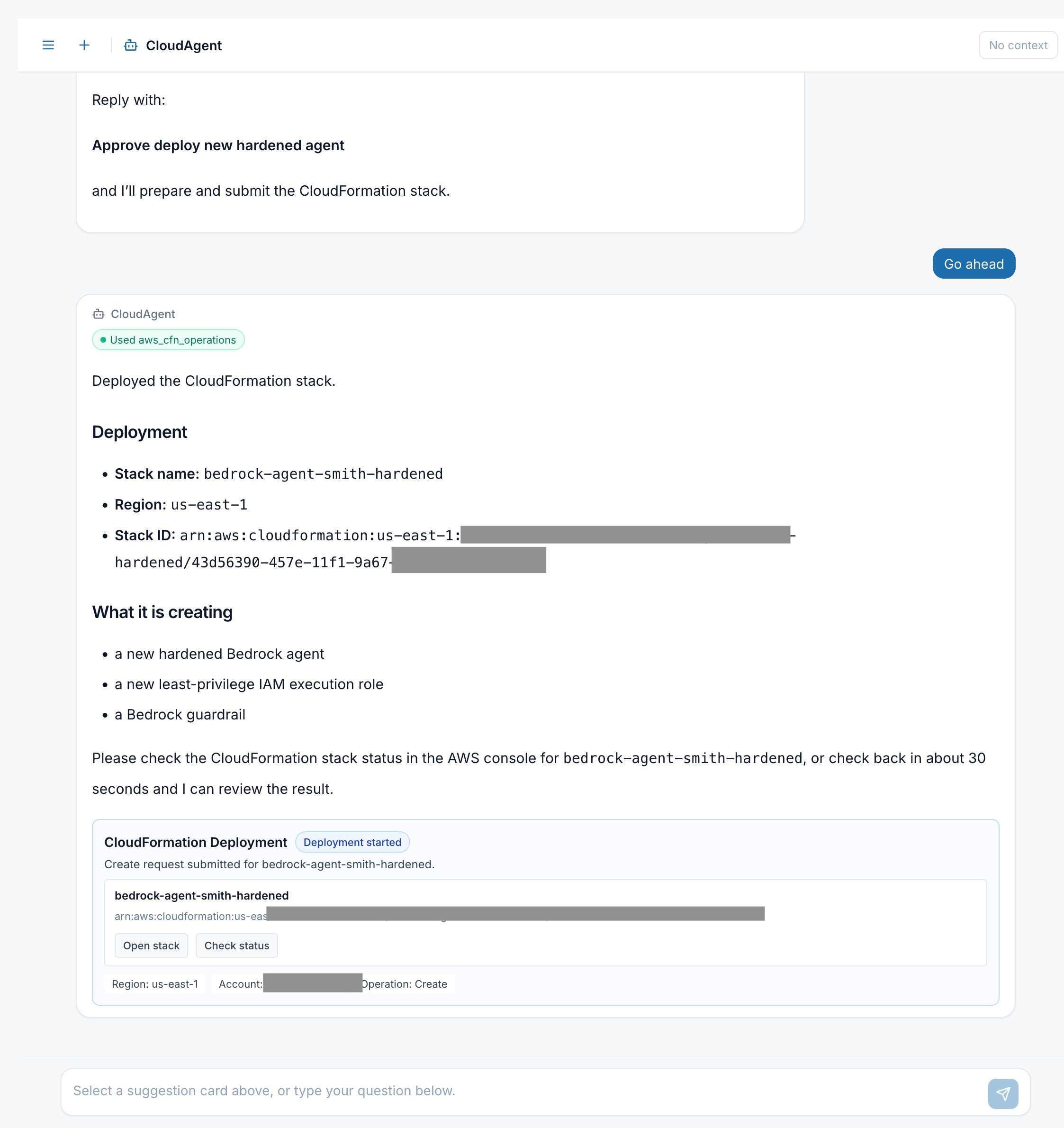
After approval, CloudAgent can deploy a hardened CloudFormation stack and report back the deployment details, including the stack name, region, and created resources.
In the example, that includes a least-privilege IAM execution role and Bedrock guardrail components.
The workflow does not stop at analysis.
It ends in a controlled deployment, with a human approval step before production changes.
Keywords to be used with metadata
- securing Bedrock agents
- Amazon Bedrock security best practices
- AI agent least privilege in AWS
- Bedrock IAM hardening
- Bedrock guardrails and governance
- CloudFormation-based agent security remediation
If you are trying to secure Bedrock agents in a production AWS account, this is the kind of workflow that makes the job easier to manage.