Blog
Lessons from the GitHub Breach
GitHub’s breach is a reminder that the most dangerous place in the enterprise may not be production. It may be the developer workstation.
A poisoned Visual Studio Code extension was enough to compromise an employee device, harvest credentials, and expose thousands of internal repositories. GitHub said the activity was contained to internal repositories and that it had not found evidence of impact to customer information outside those repos. But the lesson is broader than one incident.
When attackers can get code execution inside a trusted development environment, they do not need to fight the perimeter. They can go after the tools developers already trust, the secrets already present on disk and in memory, and the automation paths that move fastest through the organization.
What actually happened
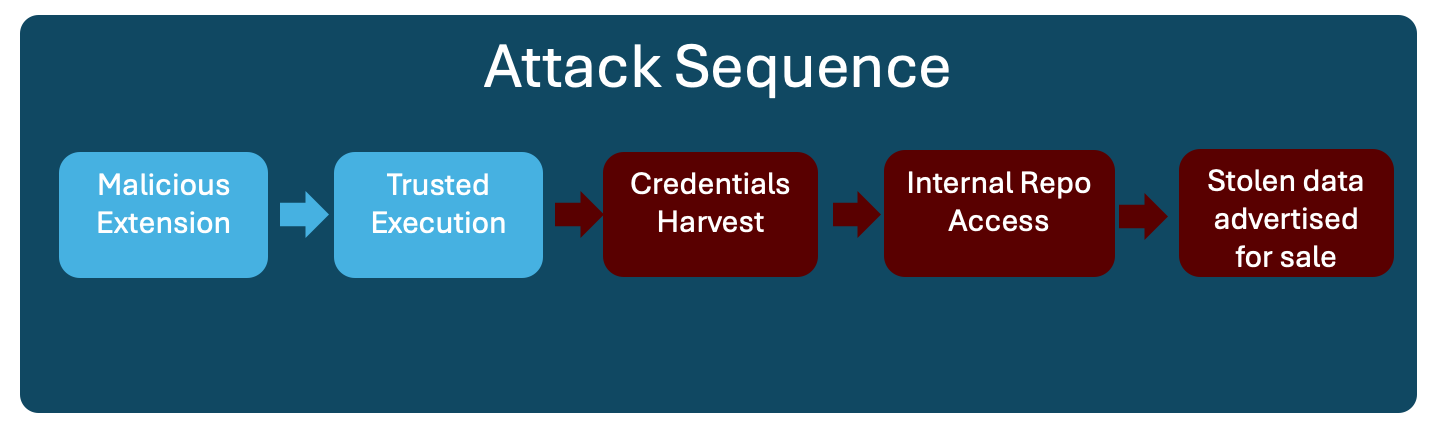
The public reporting points to a simple but effective chain:
- A malicious VS Code extension was published and installed on an employee workstation.
- The extension executed in the context of a trusted developer environment.
- The payload harvested credentials and tokens from disk, memory, and local tooling.
- Those credentials were used to reach GitHub-internal repositories and exfiltrate roughly 3,800 of them.
- The stolen data was later advertised for sale rather than used as a traditional ransom.
That sequence matters because it shows how little an attacker may need once they get inside the developer workflow. The initial access was not a noisy perimeter exploit. It was a software supply chain compromise aimed directly at a developer tool.
The reporting also shows what the payload was looking for. It targeted the things developers and platform teams actually use:
- GitHub tokens and Actions secrets
- package registry and OIDC credentials
- AWS IAM and metadata credentials
- Vault tokens
- 1Password sessions
- SSH keys, connection strings, Docker credentials, and cloud tooling
That is the real prize in these attacks. Not one machine. Not one repository. The reusable trust material that lets an attacker keep moving.
Why development environments are so attractive
Development environments are hard to lock down because they are supposed to be flexible.
Developers need access to repositories, cloud consoles, package registries, CI systems, secret managers, and internal tooling. They install extensions, run scripts, authenticate to multiple systems, and move between local and remote resources all day long. That is normal work, but it also creates a dense concentration of privileged identity, secret material, and automation access.
This is why a developer workstation is such a good target. It is trusted, powerful, and already wired into the systems attackers want.
The same is true for dependencies and developer tooling more broadly. Attackers know technical users are more likely to use a package, extension, or plugin if it looks familiar. A supply chain compromise aimed at the tools developers use can be more efficient than trying to breach production directly.
The control gap
The controls for this class of attack are not mysterious.
We know the basics:
- restrict what extensions and packages can run
- minimize long-lived credentials on developer devices
- isolate sensitive workspaces and production access
- use short-lived, scoped tokens wherever possible
- rotate secrets aggressively
- monitor for unusual execution, token use, and repo access
The hard part is not knowing the controls. It is operating them well enough to matter.
Developer environments change constantly. New extensions are added, new tokens are minted, access patterns shift, and teams move quickly under deadline pressure. A control that is correct on paper can become stale in practice if nobody is watching it, validating it, and updating it as the environment changes.
That is the gap attackers exploit.
Why continuous agents matter
This is where an always-on agent becomes useful.
If the attack surface is dynamic, the defense has to be dynamic too. A static checklist will not catch a newly installed malicious extension at the right time. A weekly review will not help if a token is harvested and used within minutes. A dashboard alone will not close the loop.
An agent can.
The right model is continuous detection plus action:
- watch for risky changes in developer environments
- flag suspicious extensions, packages, and auth patterns
- identify where secrets or broad credentials are exposed
- correlate signals across identity, endpoint, and cloud activity
- trigger remediation before the blast radius grows
That does not mean removing humans from the loop. It means moving humans to the decisions that matter most, while the machine handles the repetitive monitoring and the first pass of response.
Where CloudAgent fits
CloudAgent is built for that kind of always-on operational work.
It continuously monitors environments, detects issues, and takes action instead of waiting for someone to notice a problem in a dashboard. In a breach like this, that matters because the blast radius is often determined by speed: how quickly the compromise is detected, how quickly secrets are rotated, and how quickly risky access is contained.
For teams defending modern cloud and developer environments, the lesson is not that every workstation can be made perfectly safe. It is that the environment has to be observed and defended continuously, with detections and automated response where they can meaningfully reduce exposure.
The GitHub breach is a good case study for that reality. The attack path started with a trusted tool, moved through developer credentials, and ended with internal source code exposure. That is exactly the kind of chain where continuous monitoring and autonomous response can make the difference between a contained incident and a major compromise.
Key takeaways
- Developer environments are high-value targets because they already have the access attackers want.
- Supply chain attacks against extensions and dependencies can bypass traditional perimeter defenses.
- The necessary controls are known, but keeping them current across fast-moving environments is the real challenge.
- Continuous monitoring and agentic response are the practical way to close that gap.